
A1C 6.0: What It Means and How to Get Below 5.7
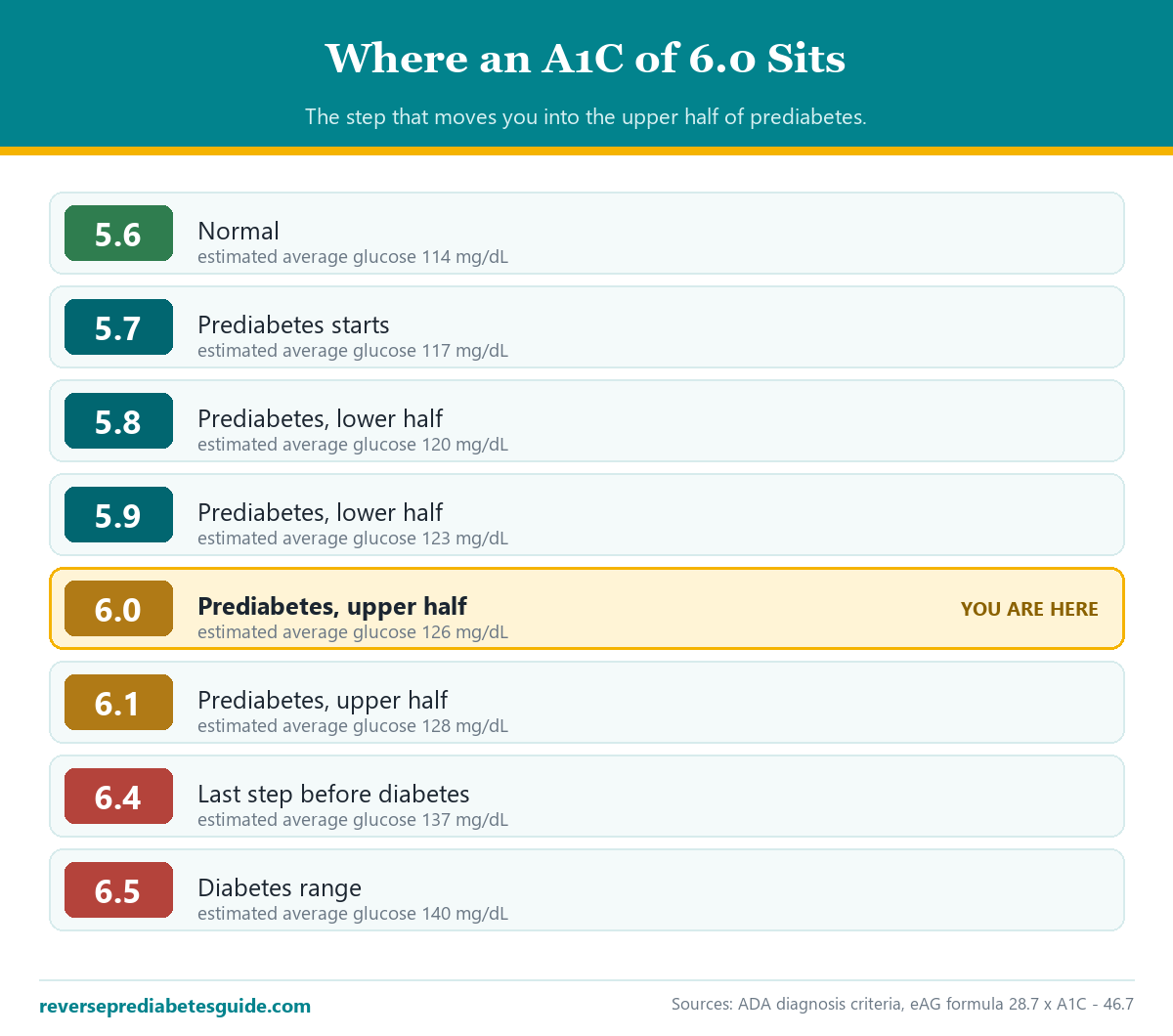
Quick Answer: An A1C of 6.0 percent is prediabetes. The CDC defines prediabetes as 5.7 to 6.4 percent, so 6.0 sits just past the midpoint, in the upper half of the range. It converts to an estimated average blood sugar of about 126 mg/dL. It is not diabetes, and 6.5 percent is still half a point away. You need to drop 0.4 points to be back under 5.7, and the number reflects the last two to three months, so retest at 90 days.
Six point zero is the number that finally scares people. Not because it is dangerous, but because of how it looks. It is round, it starts with a six, and it reads like a line you crossed.
My own first result was 6.1, one tick above yours. I brought it down to 5.4 without medication, using food and daily walking, which means I passed straight through 6.0 on the way down.
So here is what an A1C of 6.0 actually means, what genuinely changed when you crossed into the sixes, how close you are to a diabetes diagnosis, and how long the trip back takes.
Where 6.0 sits, and what changed when you crossed it
The A1C test measures the percentage of your hemoglobin that has glucose stuck to it. The CDC sorts the results into three bands: below 5.7 percent is normal, 5.7 to 6.4 percent is prediabetes, and 6.5 percent or higher is diabetes.
A 6.0 lands inside prediabetes. The band is 0.7 points wide, and 6.0 sits 0.3 above the floor and 0.5 below the ceiling, just past the middle.
What actually changed when you went from 5.9 to 6.0? Clinically, nothing. No protocol switches on at 6.0. No medication threshold, no new diagnosis, and the classification is identical on both sides of that line. What changed is that the leading digit went from 5 to 6 and your brain filed it as a category change. It is not one. It is one tenth of a point, the same size step as 5.8 to 5.9.
To make it concrete, convert A1C into estimated average glucose, or eAG. The formula comes from the ADAG study published by the American Diabetes Association: eAG in mg/dL equals 28.7 times your A1C, minus 46.7.
| A1C | Classification | Estimated average glucose | Distance from 5.7 |
|---|---|---|---|
| 5.6% | Normal | ~114 mg/dL | Below the line |
| 5.7% | Prediabetes (floor) | ~117 mg/dL | At the line |
| 5.8% | Prediabetes | ~120 mg/dL | 0.1 above |
| 5.9% | Prediabetes | ~123 mg/dL | 0.2 above |
| 6.0% | Prediabetes | ~126 mg/dL | 0.3 above |
| 6.1% | Prediabetes | ~128 mg/dL | 0.4 above |
| 6.4% | Prediabetes (ceiling) | ~137 mg/dL | 0.7 above |
| 6.5% | Diabetes | ~140 mg/dL | Above the range |
Read the glucose column instead of the percentage column for a second. Your daily average is running around 126 mg/dL, and normal territory starts around 114. That gap of roughly 12 mg/dL is not a wall. It is a large sweetened drink, or a nightly dessert, or a stretch of sitting still after every meal.
I break down all of the bands in my prediabetes A1C range explained guide, which is the hub for this whole topic.
5.9 vs 6.0 vs 6.1: does one decimal matter?
Almost everyone who searches their exact decimal is really asking a comparison question. Am I worse than last year? Am I worse than my sister, who got 5.9?
Clinically, one decimal does not matter. No treatment decision hinges on 5.9 versus 6.0 versus 6.1. All three produce the same conversation with your doctor: food, weight, movement, retest in three months.
What a decimal does tell you is direction, and only when you have more than one result to compare. Going 5.7 to 6.0 over a year means something is drifting upward. Going 6.3 to 6.0 means something you are doing is working. The slope is the signal. A single reading is a snapshot with a wide margin of error attached.
Lab variation: why the same blood can read 5.9 or 6.1
The A1C test is not precise. According to the NIDDK, a single A1C result can be up to 0.5 percentage points higher or lower than your actual value.
Sit with what that means for a 6.0. Your true value could reasonably be anywhere from about 5.5 to about 6.5. The same tube of blood, split and sent to two different labs, can come back as 5.9 at one and 6.1 at the other. Neither lab is broken. That is the normal performance of the assay.
So if you got 5.9 last year and 6.0 this year, you may not have gotten worse at all. You may have gotten the same true value measured twice by two slightly different machines.
A handful of conditions also nudge A1C without your blood sugar changing, and the NIDDK names them: anemia, kidney disease, recent blood loss or transfusion, pregnancy, and certain hemoglobin variants that occur more often in people of African, Mediterranean, or Southeast Asian descent. If any of those describe you, say so at your next appointment. Your doctor may want a fructosamine test or a fasting glucose panel instead.
Two rules I follow now. Use the same lab every time so you are comparing like with like. And never let a 0.1 swing decide how your week goes.
How close 6.0 is to a diabetes diagnosis
Here is the question underneath the search, so let me answer it plainly. A 6.0 is 0.5 percentage points below the diabetes threshold of 6.5 percent. In estimated average glucose, that is roughly 126 mg/dL versus 140 mg/dL.
You are not on the doorstep. You are also not comfortably far away, and pretending otherwise would not help you. Two things are true at once. Prediabetes is a real risk state, and the CDC is direct that people with prediabetes are at increased risk of type 2 diabetes, heart disease, and stroke. It is also one of the most reversible risk states in medicine, and the upper half of the range responds to the same changes the lower half does.
One more detail worth knowing. A diabetes diagnosis is not normally made from one A1C result. The American Diabetes Association’s Standards of Care call for confirmation, either with a repeat test or a second type of test, unless someone has unmistakable symptoms of high blood sugar. So even a future reading above 6.5 would trigger a second test, not an instant label.
The practical takeaway at 6.0: you have room, and you have a clock. Half a point of buffer and a 90 day window to change the direction of the trend line.
How long it takes to get from 6.0 to under 5.7
The thin pages ranking for this number will not answer this, so I will.
A1C reflects your average blood sugar over roughly the previous two to three months. Red blood cells live about 120 days and accumulate glucose the entire time they circulate, so the test cannot show a change faster than your red cells turn over.
The average is also weighted. Your most recent four to six weeks influence the result more than the two months before them. A strong recent stretch counts for more than an equally strong stretch back in the spring.
For the 0.4 point drop that takes you from 6.0 to under 5.7, here is the realistic arc:
- Weeks 1 to 4. Your daily glucose readings improve, sometimes within days. Your A1C has barely moved. This is where most people quit, because nothing visible has happened yet.
- Weeks 5 to 8. The new average starts dominating the calculation. A test here would show partial progress, which is precisely why testing here is a mistake.
- Weeks 9 to 12. The number catches up to the habits. This is when a 0.2 to 0.4 point drop typically becomes visible for someone who changed their eating and started walking daily.
Is 0.4 points in one 90 day cycle realistic from 6.0? For some people, yes. For others it takes two cycles, and landing at 5.8 after the first quarter is a good outcome, not a failure. Starting higher in the range usually means the trip takes longer, and that is the honest version.
My own drop went from 6.1 to 5.4, and it was months of consistency rather than one quarter, with the 6.0 zone somewhere in the middle of the descent. I mapped out the whole timeline in how long it takes to reverse prediabetes.
When to retest, and why six weeks is too early
Do not retest at six weeks. I wanted to. It is the single most common way people talk themselves out of something that was working.
At six weeks, roughly half of what the test is measuring happened before you changed anything. The result mathematically cannot reflect your new habits yet, so it understates your progress and you draw the wrong conclusion from it.
I have watched people pay out of pocket for that early test, see 5.9 instead of 5.7, decide the effort was pointless, and stop. The habits were fine. The calendar was the problem.
Retest at 90 days. Twelve weeks minimum. Same lab if you can arrange it. A1C does not require fasting, though your doctor may want you fasting if a glucose panel is running alongside it.
If you want feedback sooner, and you should, buy an inexpensive glucose meter. A fasting reading in the morning and one taken two hours after your largest meal will tell you within a week whether your changes are landing. Compare what you see against normal blood sugar levels by age so you know what you are aiming at.
Meter for weekly feedback. A1C for the quarterly verdict. Keeping those two jobs separate is what stopped me from checking a number that could not possibly have moved.
The changes that move the number most
Not every change pays the same. Sorted by return on effort, here is what actually moved mine, and it matches what the research says.
Modest weight loss. The Diabetes Prevention Program, the largest trial of its kind in the United States, found that losing about 7 percent of body weight and getting 150 minutes of activity per week cut the risk of progressing to type 2 diabetes by 58 percent over three years, per the NIDDK. For a 200 pound person, 7 percent is 14 pounds. That is a modest, unglamorous number, and it is the one that works.
Cutting the carbs that spike you specifically. Not all carbs, and not down to zero. The refined ones that send you high and hold you there. I found my personal ceiling with a meter rather than a rulebook, then settled into a moderate intake I could live with. The method is in the best way to lower A1C naturally.
Walking after meals. My highest return per minute of effort, and the easiest thing on this list to start tonight. A review in Sports Medicine found that short bouts of light walking spread through the day lowered post-meal glucose compared with uninterrupted sitting (Buffey et al., 2022). Ten to fifteen minutes after your biggest meal is enough to see on a meter. I wrote up what it did to my own readings in walking after meals and blood sugar.
Sleep and stress. Harder to measure, still real. My fasting readings were reliably worse after short nights. If your fasting number looks strange and your food has not changed, look at your sleep before you rebuild your diet again.
If you would rather not assemble all of this yourself, my 7-day prediabetes meal plan gives you a week of meals that already hit these targets, and the just diagnosed prediabetes 30-day plan sequences the first month so you are not changing nine things at once.
If your number went UP to 6.0
A lot of people reading this did not start at 6.0. They started at 5.7 or 5.8 a year or two ago and watched it climb.
If you went from 5.7 to 6.0, read it in two layers. Layer one is the measurement question: with a margin of error up to 0.5 points, a 0.3 move across two different labs is not proof of anything on its own. Layer two is the pattern question: if this is the third result in a row that went up, the error bars stop being a comfortable explanation. Three rising readings is a trend, and a trend is real information.
An upward drift usually has an ordinary cause behind it, not a mysterious one. Weight gain, a job change that killed your walking, worse sleep, a new medication, more alcohol, more takeout. Before you look for something exotic, look at what your last twelve months actually looked like compared with the twelve before.
One thing worth flagging here has nothing to do with willpower. Ask your doctor whether anything on your medication list can raise blood sugar. Corticosteroids and some other common prescriptions can, and that is a conversation, not a personal failing.
The good news buried in an upward trend is that trends respond to input. The same drift that took you from 5.7 to 6.0 can run in reverse, and it usually runs faster in reverse, because this time it is deliberate.
Do supplements help at 6.0? An honest answer
Not one page currently ranking for this number mentions supplements at all, which is odd, because it is one of the first things people search after the result lands. So let me answer it, and let me answer it straight.
Supplements are not what moves a 6.0. Food and walking are. The National Center for Complementary and Integrative Health reviews the evidence on the popular blood sugar ingredients, cinnamon and chromium among them, and the summary is consistent: the research is limited, mixed, and does not support them as a treatment.
Practically, at 6.0 that means this. If you take a supplement and change nothing else, expect your next A1C to look a great deal like this one. The 0.4 points you are chasing come from your plate and your shoes.
If you are still curious about a supplement, give it the right job: a small add-on on top of carbs and post-meal walks that are already dialed in and holding. An adjunct on top of a foundation that already exists, never a replacement for building one.
If you want to see what one of these products actually contains before you spend anything, I read a liquid formula’s full label, kit prices and refund terms in my Olivaro review, and I cover the research on single ingredients in my guide to supplements to lower A1C. If your budget this month is a choice between a bottle and a glucose meter plus better groceries, buy the meter and the groceries. That is the order of operations, not modesty.
One more thing said plainly: if you take any prescription, check with your pharmacist before adding a supplement. Interactions are real, and blood sugar ingredients are not exempt from them.
Affiliate disclosure: some links in this article are affiliate links, which means I may earn a small commission if you buy through them, at no extra cost to you. That never changes what I write here.
When your doctor will bring up metformin
At 6.0, some doctors will mention it and many will not. You are in the upper half of the prediabetes range, which raises the odds the conversation happens, but lifestyle is still the standard first move.
The ADA Standards of Care describe who metformin is most often considered for in prediabetes: people with a BMI of 35 or higher, people under 60 years old, and women with a history of gestational diabetes. A higher A1C within the prediabetes range also weighs into that judgment.
Context worth carrying into that appointment: in the Diabetes Prevention Program, metformin reduced progression to type 2 diabetes by 31 percent, while the lifestyle changes reduced it by 58 percent, per the NIDDK. Lifestyle beat the drug in that trial.
If you are weighing a prescription against the natural route, or wondering where berberine fits into that picture, I compared them side by side in berberine vs metformin for prediabetes.
None of this makes metformin a defeat. Some people need it and do better with it. At 6.0 specifically, you very likely have room to try food and movement first, and 90 days to find out how far that takes you.
Key Takeaways
- An A1C of 6.0 percent is prediabetes, sitting just past the midpoint of the 5.7 to 6.4 range.
- It converts to an estimated average glucose of about 126 mg/dL using the ADA formula.
- Nothing clinical changes between 5.9 and 6.0. The leading digit changed, not the diagnosis.
- You are 0.5 points below the diabetes threshold, and a diagnosis normally requires a second confirming test.
- A single A1C can be off by up to 0.5 points, so the same blood could read 5.9 or 6.1.
- Retest at 90 days. A test at six weeks is measuring your old habits as much as your new ones.
- Weight loss of about 7 percent plus 150 minutes of weekly activity cut diabetes risk by 58 percent in the DPP.
- Supplements are an adjunct at best. Diet and walking do the heavy lifting at this level.
Frequently Asked Questions
Is 6.0 A1C bad?
A 6.0 is not bad in the sense of dangerous or urgent, but it is a real signal. It is prediabetes, sitting in the upper half of the 5.7 to 6.4 range, with an estimated average glucose around 126 mg/dL. It is a number worth acting on within the next 90 days, and it is not a number worth losing sleep over tonight.
Is 6.0 A1C close to diabetes?
You are 0.5 percentage points away from the 6.5 percent diabetes threshold, which is roughly 14 mg/dL in estimated average glucose. That is close enough to take seriously and far enough that you have real room to work. A diabetes diagnosis also normally requires a confirming second test, so one reading above 6.5 would not settle it by itself.
What blood sugar is an A1C of 6.0?
Using the ADA’s estimated average glucose formula, 6.0 percent works out to about 126 mg/dL as a daily average, or roughly 7.0 mmol/L. That figure averages every hour of the day, so your fasting reading is usually lower than that and your post-meal peaks are higher.
My A1C went from 5.7 to 6.0, what happened?
Possibly less than you think. A single A1C can vary by up to 0.5 percentage points, so a 0.3 move between two labs can be measurement noise. If this is the third consecutive result trending upward, treat it as a real trend and look at the ordinary causes first: weight, activity, sleep, alcohol, and any new medication that can raise blood sugar.
How do I lower my A1C from 6.0?
The three changes with the best evidence behind them are modest weight loss of around 7 percent, 150 minutes of weekly activity, and cutting the refined carbohydrates that spike you personally. A 10 to 15 minute walk after your largest meal is the easiest place to start. Plan on a full 90 days before the number reflects any of it, and use a glucose meter for feedback in the meantime.
Do I need medication at an A1C of 6.0?
Usually not as a first step. Standard practice at 6.0 is lifestyle change with a retest in three months. The ADA describes metformin as most often considered for people with a BMI of 35 or higher, people under 60, and women with a history of gestational diabetes. Whether it applies to you is a conversation with your doctor, not something a decimal decides on its own.
Before You Go
- Write today’s date and set a reminder 90 days out. That is your retest, and nothing before it counts.
- Buy an inexpensive glucose meter this week so your feedback loop is weekly instead of quarterly.
- Add a 10 to 15 minute walk after your largest meal, starting tonight.
- Pick one refined carb you eat every day and swap it for a fiber-rich version.
- Note which lab ran this test and use the same one next time.
- Ask your doctor whether anything on your medication list can raise blood sugar.
A 6.0 looks worse than it is because of the digit in front. You are three tenths of a point from normal, half a point below diabetes, and the two things that move the number most cost nothing.
Start with the full A1C range breakdown if you want to see where every number sits, then come back in three months with a new result. I would bet on you.
Medical disclaimer: I am not a doctor. I am someone who reversed my own prediabetes and writes about what I learned. This article is educational and is not medical advice, diagnosis, or treatment. Always talk with your physician or a registered dietitian before changing your diet, starting a supplement, or making decisions about medication.