Prediabetes Diet Questions Answered (What I Wish I’d Known)
The night I was diagnosed with prediabetes, I sat at my kitchen table with my phone and typed question after question into the search bar. Can I still eat bread? Do I have to give up fruit? Is my morning coffee ruining everything? By midnight I had 40 browser tabs open and felt more scared than when I started.
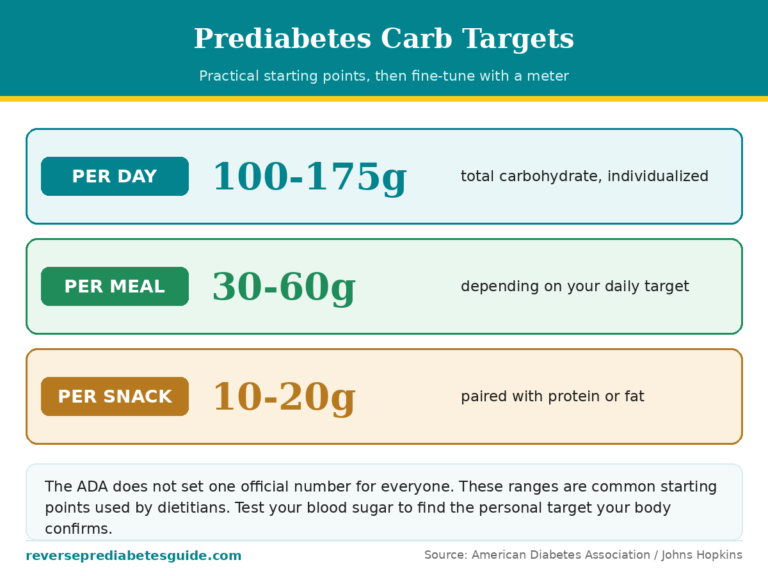
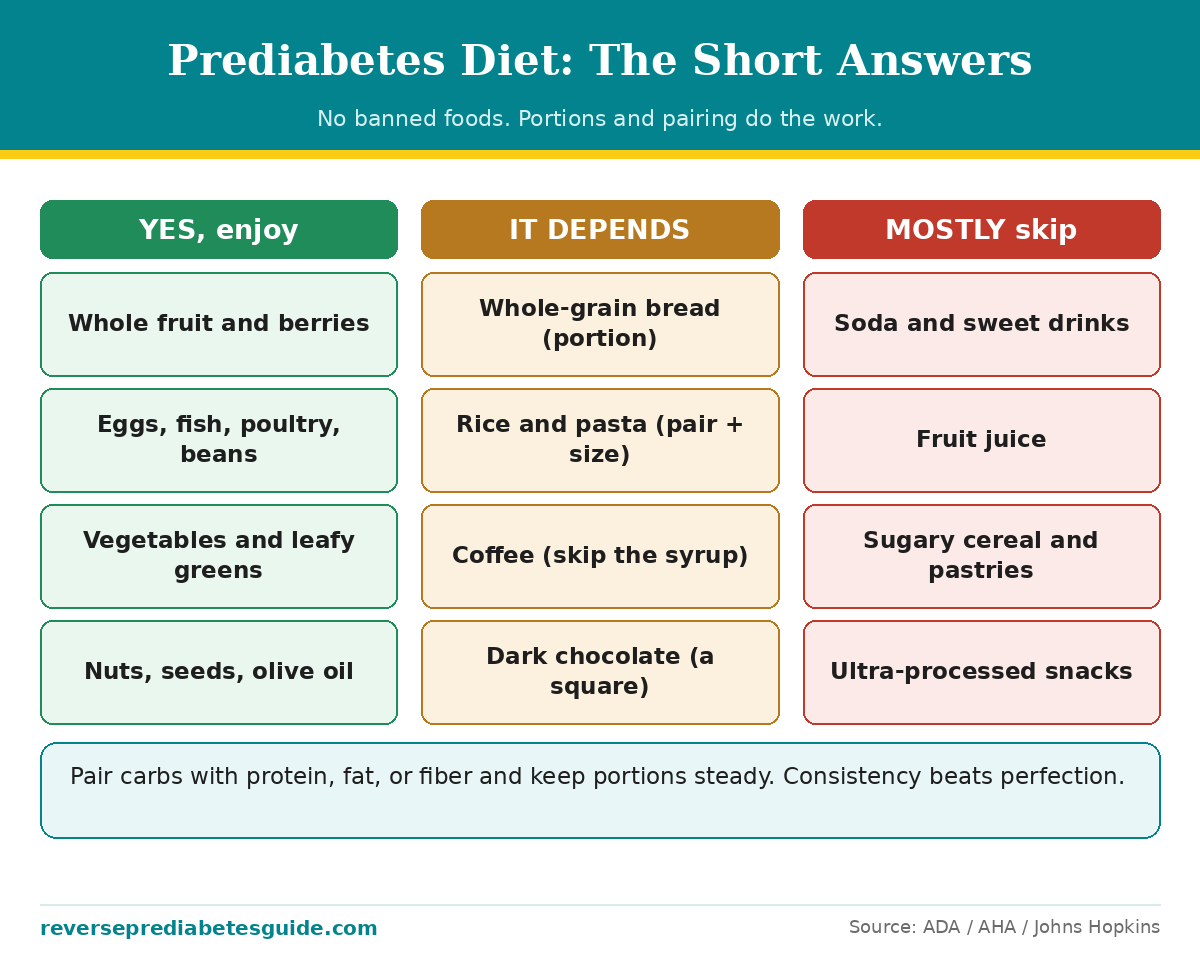
Quick Answer: Yes, you can still eat carbs, fruit, and bread with prediabetes. There is no single banned food. What matters most is total daily carbohydrate load, portion size, pairing carbs with protein, fat, and fiber, and consistency. Most people with prediabetes do well between roughly 100 and 175 grams of carbs per day, individualized with a doctor or dietitian.
Here is the part nobody told me that first night, and the part I want you to hear right away: prediabetes is often reversible. It is a warning light, not a life sentence, and the food changes that help are far less scary than the internet made them sound. I lowered my own A1C from 6.1 to 5.4 in about eight months, and I promise you I did not give up every food I love.
This is the collection of prediabetes diet questions answered the way I wish someone had laid them out for me that night. Plain answers, my real experience, and my verdict first so you are not left guessing. Let’s go through the questions that probably kept you up too.
First, what prediabetes actually means for your plate
Prediabetes means your blood sugar is higher than normal but not yet in the diabetes range. According to the American Diabetes Association, that usually means an A1C between 5.7 and 6.4 percent, a fasting blood sugar between 100 and 125 mg/dL, or an oral glucose tolerance test result between 140 and 199 mg/dL.
I found it helpful to think of that number as a dashboard warning light. It is telling you something needs attention, and it is showing up early enough that you can do something about it. In fact, according to the CDC, more than 1 in 3 US adults have prediabetes, and most of them do not know it, so if anything you are ahead by simply paying attention.
What it means for your plate is not a punishment menu. It means being a little more intentional about how much carbohydrate you eat, how you combine your food, and how often you move your body. That is most of it.

The most common prediabetes diet questions, answered
Can I still eat carbs?
Yes. Carbs are not the enemy, and cutting them to zero is neither necessary nor realistic for most of us. What raises blood sugar is the total amount of carbohydrate you eat in a sitting and across the day, so the goal is to manage the load, not to fear it.
The ADA does not set one universal carb number, and Johns Hopkins makes the same point: your target should be individualized. As a practical starting range, many people with prediabetes do well somewhere between 100 and 175 grams of carbs per day, spread across meals. I aimed for the lower-middle of that range and checked how I felt and, later, what my numbers did.
Do I have to give up fruit?
No. Whole fruit stays. This was the myth that upset me most, because fruit was never my problem food.
Whole fruit comes packaged with fiber, which slows down how fast the sugar hits your bloodstream. Fruit juice does not have that brake, so a glass of juice affects you very differently than the whole orange it came from. I lean on berries because they are lower in sugar and high in fiber, and I keep an apple in my bag most days. If you want a deeper list, I put together my go-to options in foods that lower blood sugar quickly.

Is bread completely off-limits?
No, though this is where portion and type matter a lot. I still eat bread. I just eat it differently than I used to.
I switched to 100 percent whole grain bread and sourdough, which tend to affect blood sugar more gently than soft white bread. I watch the portion, usually one slice rather than two, and I never eat it alone. Pairing it with protein and fat, like eggs or avocado, softens the blood sugar rise. If you want to understand why some breakfast breads behave better than others, my breakdown of glycemic index breakfast foods walks through it.
How much sugar can I have per day?
The number that matters here is added sugar, not the natural sugar found in whole fruit or plain dairy. Added sugar is the stuff stirred in during processing or cooking.
The American Heart Association suggests keeping added sugar to about 25 grams per day for women and about 36 grams per day for men. Once I started reading labels, I was shocked at how fast a flavored yogurt or a bottled coffee drink used up that budget. Naturally occurring sugar in an apple or a bowl of berries does not count the same way, because it comes wrapped in fiber and nutrients.
What should I eat for breakfast?
Protein first. This was the single change that made mornings easier for me. A protein-forward breakfast keeps me full and keeps my blood sugar steadier than the cereal-and-toast mornings I used to have.
Think eggs, plain Greek yogurt, cottage cheese, or a tofu scramble, with some fiber and a little healthy fat alongside. If you want ready-made ideas so you are not deciding at 7 a.m., I collected my rotation in best breakfast ideas for prediabetes.
Do I need to go keto?
No. Keto can work for some people, but it is not required to lower your numbers, and it was too restrictive for me to stick with long term. A moderate approach, managing carb portions and pairing foods well, worked and I could actually maintain it.
Consistency beats intensity here. A moderate plan you follow for a year will do far more than a strict one you quit in three weeks. Some people also find a gentle eating window helpful as an optional tool, and I wrote about my careful experience with it in intermittent fasting and prediabetes. It is a tool, not a rule.
Why is my blood sugar high in the morning?
If your fasting number is stubbornly high even though you did nothing wrong overnight, you are probably meeting the dawn phenomenon. In the early morning hours your body releases hormones that nudge blood sugar up to help you wake, and in prediabetes that rise can be a little exaggerated.
It is common and usually not a sign you failed. I have practical strategies that helped me in how to lower fasting blood sugar in the morning, and if you are also trying to make sense of your after-meal readings, blood sugar after eating with prediabetes explains what is normal.
What foods should I avoid or limit?
Rather than a banned list, I think of it as a short limit list. The foods worth pulling back on are refined carbohydrates like white bread and pastries, sugar-sweetened drinks like soda and sweet tea, and heavily ultra-processed foods.
Sugary drinks were the biggest lever for me, because they raise blood sugar fast and do not fill you up. I did not eliminate everything overnight. I traded down gradually, and it stuck better that way. For the full picture, I keep an updated rundown in foods to avoid with prediabetes.
Will supplements help lower my A1C?
Food and movement come first, always. That is where the real, reliable change happens. The evidence on supplements for blood sugar is mixed, and no capsule replaces the basics of portions, pairing, and walking.
That said, plenty of people ask me about them, so I researched the category honestly and shared what I found in best supplements for prediabetes to lower A1C. One product readers ask about is Olivaro, a liquid formula. I did not take it. I read its label, prices and refund terms and wrote up what they show, including the weak points. Read our Olivaro review.
This is my personal experience, not medical advice. Supplements can interact with medications, so talk with your doctor before adding anything, and never use a supplement in place of the food and lifestyle changes that do the heavy lifting. Note: some links in this article are affiliate links, which means I may earn a small commission at no extra cost to you if you buy through them. It never changes what I recommend or what I honestly tell you.
Disclosure: Some links in this article are affiliate links. If you buy through them, I may earn a small commission at no extra cost to you. I only mention products I have personally tried, and my opinion is my own.
What actually moved my numbers (A1C 6.1 to 5.4)
People assume I overhauled my whole life. I did not, and I was far from perfect. Over about eight months, a handful of ordinary habits did most of the work.
First, I ate protein at every meal and stopped eating carbs on their own. Second, I started walking for 10 to 15 minutes after dinner, which quietly became my favorite habit. Third, I cut sugary drinks down to almost nothing and drank water or unsweetened tea instead. Fourth, I kept meals simple and repeatable so I was not white-knuckling decisions every day.
What surprised me most was how forgiving the process was. I had birthday cake. I had pasta nights. I had weeks where the walks did not happen and the takeout did. My numbers still moved, because I was consistent most of the time, not perfect all of the time. That mindset shift, aiming for most days instead of every day, is probably the reason I stuck with it long enough to see the A1C change.
None of it required a chef or a boot camp. If you want a plug-and-play version of how I ate, I laid it out in my 7-day prediabetes meal plan, and the after-dinner walking habit gets its own deep dive in walking after meals and blood sugar.
Key Takeaways
- There is no single banned food with prediabetes.
- Aim for roughly 100 to 175 grams of carbs per day, individualized with your doctor.
- Pair carbs with protein, fat, and fiber to blunt blood sugar spikes.
- Whole fruit is fine, juice is the thing to watch.
- Food and movement matter far more than any supplement.
Frequently Asked Questions
Can prediabetes be reversed with diet alone?
For many people, yes, diet and lifestyle changes can bring blood sugar back into the normal range, which is often called reversing or remitting prediabetes. Movement and weight changes usually help too, so it is rarely diet in a vacuum. Reversal is common but not guaranteed, so work with your doctor to track your own numbers.
How long does it take to lower A1C with diet?
The A1C test reflects your average blood sugar over roughly the past two to three months, according to the NIDDK, so meaningful change shows up on that timeline at the earliest. In real life it often takes longer to build lasting habits. It took me about eight months to go from 6.1 to 5.4, and I count that as a normal pace.
Is intermittent fasting safe with prediabetes?
It can be for some people, but it is not right for everyone, especially if you take medication that lowers blood sugar or have a history of disordered eating. I approached it gently and paid close attention to how I felt. Talk with your doctor before trying it, and treat it as one optional tool rather than a requirement.
Can I drink coffee or alcohol?
Coffee is generally fine, and I still have my morning cup. The catch is what goes in it, since flavored syrups and sweetened creamers add up fast. Alcohol is best kept moderate, since it can affect blood sugar in both directions, so check with your doctor about what fits your situation.
Do I need to count every carb forever?
No. Counting closely for a few weeks is a great way to learn what your usual portions actually contain, but most people can shift to eyeballing it once they get the feel. I counted carefully early on and now I mostly estimate. The goal is awareness, not a spreadsheet for life.
Is a prediabetes diet the same as a diabetic diet?
They overlap a lot, since both focus on managing carbohydrate load, portions, and steady blood sugar. The main difference is intensity and medical oversight, since diabetes often involves tighter targets and sometimes medication. The everyday plate looks very similar, which is good news because the habits transfer.
Should I see a dietitian?
If you can, yes. A registered dietitian can turn general advice into a plan built around your food preferences, budget, and health history, and that individualization is exactly what the guidelines recommend. Many insurance plans cover it after a prediabetes diagnosis, so it is worth asking.
If you want to zoom out and understand the whole condition, my complete guide to prediabetes ties it all together, and if you were just diagnosed and want a step-by-step start, try the just diagnosed prediabetes 30-day plan.
That is my honest run through the biggest prediabetes diet questions answered from lived experience rather than a textbook. If you take one thing from all of this, let it be that you did not fail, and you do not have to eat sad food to turn your numbers around. Start with one meal, one walk, one swap, and let it build from there.
When you are ready for a done-for-you week of meals, my 7-day prediabetes meal plan is the gentlest place to begin.
Before You Go
- Pick one carb-heavy meal this week and add a protein and a vegetable to it.
- Take a 10-minute walk after your biggest meal of the day.
- Swap one sugary drink for water or unsweetened tea.
- Ask your doctor about a referral to a registered dietitian.
Medical disclaimer: This article is for informational purposes only and reflects my personal experience with prediabetes. It is not medical advice and is not a substitute for professional care. Prediabetes is a medical condition, and everyone’s numbers, medications, and health history are different. Always talk with your doctor or a registered dietitian before making changes to your diet, exercise, or supplement routine.