A1C 6.1: What It Means and How I Got Mine to 5.4
My A1C came back at 6.1 and I stared at the number for a long time before I did anything else.
I knew enough to know that 6.5 is diabetes. So my brain did the only math it could do in that moment: I was four tenths of a point away. Not four points. Four tenths.
Quick Answer: An A1C of 6.1 is prediabetes, not diabetes. It sits in the upper half of the prediabetes range, which runs from 5.7 to 6.4, and it is 0.4 below the 6.5 diabetes cutoff. It is a serious number and also a reversible one. Mine was 6.1, and with diet changes and daily walking, without medication, it came down to 5.4.
This article is not a textbook definition of 6.1. This is what happened after my 6.1: what my doctor and I talked about, what I changed, what moved the number, what did nothing, and how long the whole thing realistically takes.
I am not a doctor. I am someone who got that number, panicked, read too much, and then did the boring work. If that is where you are tonight, keep reading.
Is 6.1 diabetes or prediabetes?
Prediabetes. Clearly and definitionally prediabetes.
The American Diabetes Association puts the diabetes threshold at an A1C of 6.5 percent or higher, and the prediabetes range at 5.7 to 6.4 percent. At 6.1 you are inside the prediabetes band with room on both sides of you.
But I want to be honest about why that reassurance only half works. Being told “it is just prediabetes” at 6.1 feels different than being told it at 5.8. You are in the part of the range where the next lab could go either way, and that feeling is not irrational. It is the correct reading of the number. What it should produce is attention, not despair.
The exact cutoffs, and what each one means in real blood sugar
A1C is a percentage, which makes it hard to feel. It measures how much sugar has attached itself to your red blood cells over their lifespan, which is roughly three months, according to the NIDDK.
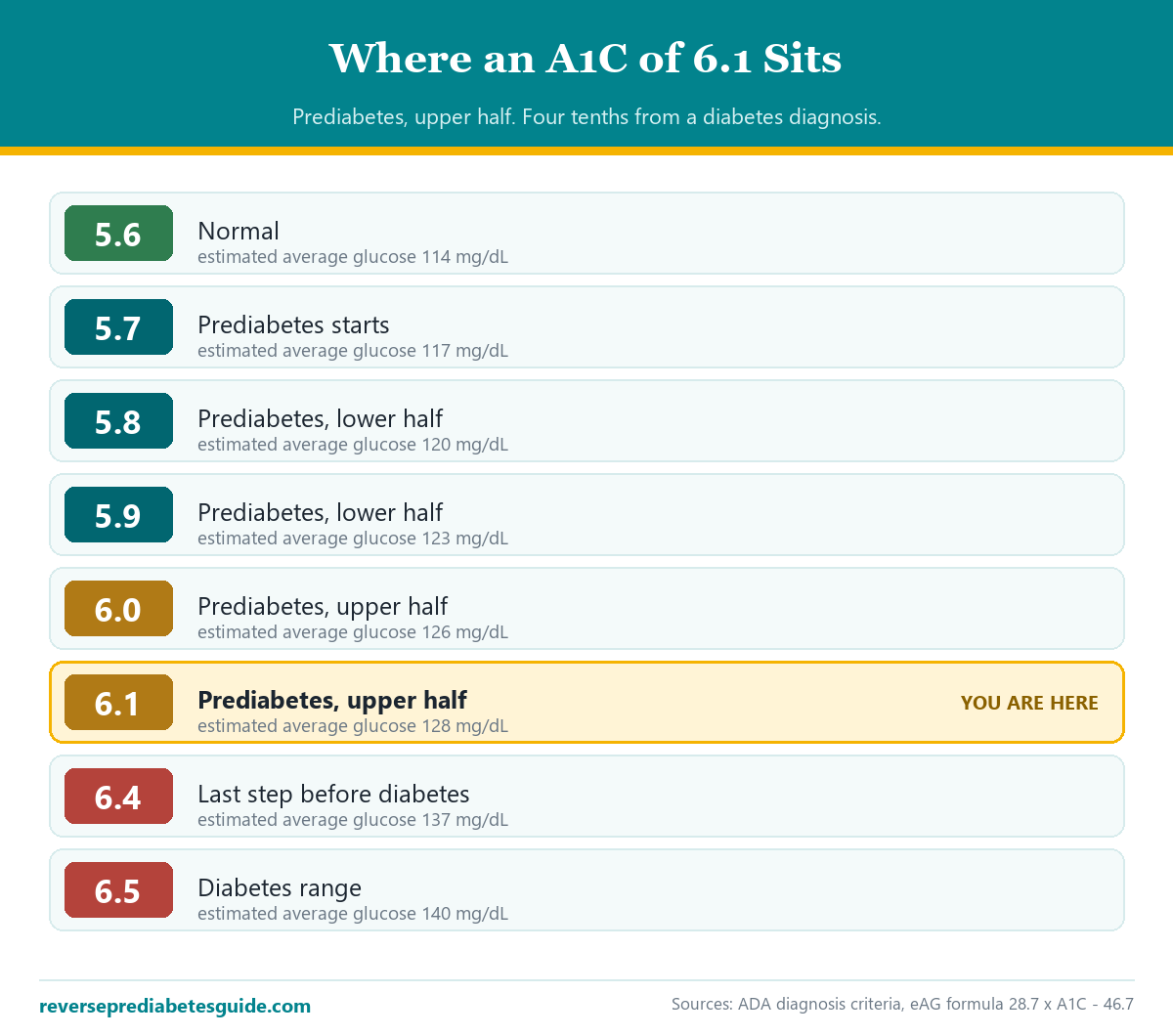
Estimated average glucose, or eAG, converts that percentage into the mg/dL number you would see on a glucose meter. It uses a standard formula published by the ADA. Here is the whole scale in one place.
| A1C | Category | Estimated average glucose |
|---|---|---|
| Below 5.7 | Normal | Under about 117 mg/dL |
| 5.7 to 5.9 | Prediabetes, low range | About 117 to 123 mg/dL |
| 6.0 to 6.2 | Prediabetes, mid to high range | About 126 to 131 mg/dL |
| 6.1 | Prediabetes, high range | About 128 mg/dL |
| 6.3 to 6.4 | Prediabetes, top of range | About 134 to 137 mg/dL |
| 6.5 and above | Diabetes | About 140 mg/dL and up |
eAG values calculated with the ADA conversion formula. Individual meter readings vary.
Seeing 6.1 translated into roughly 128 mg/dL was the first thing that made it concrete for me. My blood sugar was averaging around 128 all day, every day, including while I slept. Not spiking to 128 after dessert. Averaging it.
If you want the full breakdown of every band and what separates them, I walk through it in the prediabetes A1C range explained.
How close 6.1 really is to a diabetes diagnosis
Here is the part I could not find written down anywhere when I needed it.
The gap between 6.1 and 6.5 is 0.4 percentage points, which translates to roughly 12 mg/dL of average blood sugar. That is a small distance. It is also not a countdown clock.
Prediabetes does not automatically progress. The CDC notes that without intervention, a meaningful share of people with prediabetes go on to develop type 2 diabetes within about five years. The key phrase in that sentence is “without intervention.”
The direction matters more than the position. A 6.1 that has been drifting up from 5.8 over two years is a different situation than a 6.1 that just appeared after a rough year. Same number, different story, which is why your old lab results are worth digging up before your next appointment.
The other thing that changed how I saw the number: the same short distance works in both directions. I needed 0.4 to get to 5.7 and out of the range entirely. That is the exact same distance.
What happened when I got my 6.1
The result came through a patient portal, which I do not recommend as a way to receive news like that. There is no one in the room to ask a question.
My first move was the worst possible one. I searched the number at night and read for hours, mostly forum posts from people in much worse situations than mine. By the time I stopped, I had convinced myself I was already diabetic and just had not been told yet.
What actually helped was the conversation with my doctor, and not because it was dramatic. It was calm. We talked about the number as a warning rather than a verdict, about what I ate and how much I moved, and about when to test again rather than what to do this week in a panic.
I want to be careful here, because I am writing this from memory rather than a transcript. I am not going to put words in my doctor’s mouth or give you a date. What I can tell you truthfully is the shape of it: nobody talked about medication at 6.1, the plan was lifestyle first, and the timeline was measured in months rather than weeks.
I walked out with something I did not have going in, which was a next step. If you are heading into that appointment now, I made a list of 6 questions to ask your doctor about prediabetes so you do not blank out the way I nearly did.
Will my doctor put me on metformin at 6.1?
Probably not, and this is one of the biggest gaps I found when I searched. Almost nobody answers it directly.
Metformin is not standard treatment for prediabetes across the board. The ADA’s Standards of Care recommend considering metformin for diabetes prevention in specific higher-risk groups rather than for everyone with prediabetes: broadly, people aged 25 to 59 with a BMI of 35 or higher, a fasting glucose of 125 mg/dL or above, an A1C at the top of the range combined with other risk factors, or a history of gestational diabetes. The current recommendation is in the ADA’s Prevention or Delay of Diabetes chapter.
So 6.1 by itself is usually not the trigger. Your other risk factors are what tip the conversation.
There is a real reason lifestyle comes first, and it is not doctors being cautious. In the Diabetes Prevention Program trial, the landmark study on this question, an intensive lifestyle program cut the incidence of type 2 diabetes by 58 percent, while metformin cut it by 31 percent. The lifestyle arm outperformed the drug. That result is published in the New England Journal of Medicine and it is the single most useful fact I learned during all of this.
If medication does come up in your case, it is worth understanding the alternatives people ask about. I compared the two most common questions in berberine vs metformin for prediabetes, and I tackled the bigger question honestly in can supplements replace prediabetes medication. The short version of both: no supplement is a metformin substitute, and if your doctor prescribes something, take it.
What I changed, in order of impact
I did not change everything at once. I tried to, briefly, and then collapsed back into old habits the way everyone does. What worked was doing fewer things and doing them boringly.
What moved the number most
Walking after meals. This is first because it was first. Ten to fifteen minutes after dinner, then eventually after lunch too. It is the highest return per unit of effort of anything I did, and it costs nothing. Muscles pull glucose out of the bloodstream during light activity, which is why the timing matters more than the intensity. I went deeper on the mechanism in walking after meals and blood sugar.
Cutting liquid sugar to near zero. Sweetened drinks hit fast and do not fill you up, which makes them the cheapest thing to give up relative to what you get back. This was the single change that required no cooking, no planning, and no willpower after the first two weeks.
Never eating a carb alone. Not cutting carbs. Pairing them. Bread with eggs, rice with chicken and vegetables, fruit with nuts or yogurt. Protein, fat, and fiber slow the absorption, and the meal lands softer. This let me keep foods I would otherwise have quit and then binged.
Eating protein at breakfast. The cereal-and-toast morning was setting the tone for my whole day. Switching the first meal steadied everything after it, and it was one decision made once instead of six decisions made under pressure.
What I tried that did nothing
Cinnamon in everything. I put it in coffee, oatmeal, and yogurt for weeks based on internet enthusiasm. Nothing measurable. The research on cinnamon and blood sugar is thin and inconsistent, and I would not spend effort there again.
Going low-carb hard. I lasted under two weeks and then ate an entire loaf of bread. Restriction I could not sustain produced worse results than moderation I could. This is the part of my story I am least proud of and most sure about.
Weighing myself daily. It made me anxious and told me nothing useful, because daily weight is mostly water. It also pulled my attention toward a number that was not the number I was trying to change.
Testing my blood sugar constantly at first. I bought a meter and poked myself after everything, which produced a lot of readings and a lot of alarm without a framework to interpret them. Occasional purposeful testing helped. Anxious testing did not.
If you want this as a structured starting sequence instead of a list, I built the just diagnosed prediabetes 30-day plan around exactly this order of operations.
How long it takes to get from 6.1 to under 5.7
This is the question I wanted answered most and found least, so let me be specific about what is knowable and what is not.
What is knowable: A1C reflects roughly the previous two to three months of average blood sugar, because that is the lifespan of a red blood cell. That means retesting sooner than about three months does not tell you much. The NIDDK is clear on this timeline, and it is why your doctor will not order a new A1C in six weeks no matter how well you have been eating.
Recent weeks are weighted a little more heavily than older weeks in that average, so changes do show up before the full three months elapse. But the number you get at month three still includes the version of you from month one. That is worth knowing so you do not read a partial result as a failure.
What is not knowable: exactly how many months it will take you, or took me. I am not going to give you my month count, because I did not track it precisely enough to state it as a fact, and a made-up number in a health article is worse than no number at all.
What I will tell you truthfully is that it was more than one retest cycle, and the change from 6.1 to 5.4 happened without medication, through food changes and daily walking. That is the part that matters for whether it is possible for you. For the timelines other people report and what the research says about the pace of change, I collected it in how long it takes to reverse prediabetes.
One practical note. Ask for the retest to be scheduled before you leave the appointment. An A1C three months out that is already on the calendar is a deadline. An A1C you are supposed to remember to book becomes an A1C you get eleven months later.
Where a supplement fits, and where it does not
Food and walking did the heavy lifting. Not most of it. Nearly all of it. If you do nothing from this article except walk after dinner and stop drinking sugar, you will have captured the majority of what is available to you, and you will have spent nothing.
Supplements are adjuncts at best. They are the last ten percent, and only after the first ninety percent is in place. Taking a capsule while nothing else changes is buying a feeling, not a result.
That said, readers ask constantly, so here is my honest position. Some people find a blood sugar support supplement helps with the part that is hardest to white-knuckle, which is cravings and the afternoon crash that sends you to the vending machine. If that is your specific failure point, it can be worth trying. If your failure point is that you have not started walking, it will not help you. If you want to see what one of these formulas actually contains, I read Olivaro’s full label, kit prices and refund terms in my Olivaro review. I did not take it, so the review sticks to what the documents show.
Before you buy anything, read can prediabetes be reversed naturally and reverse prediabetes naturally in 30 days. If those two articles do not describe what you are already doing, a supplement is the wrong next purchase.
Disclosure: Some links in this article are affiliate links. If you buy through them, I may earn a small commission at no extra cost to you. It never changes what I recommend or what I honestly tell you, and I would rather you spend the money on groceries.
If your number went up to 6.1
There is a specific version of this reader I want to speak to directly: the person who was 5.8 last year and is 6.1 now.
That is a different situation than a first-time 6.1, and it deserves a different response. You have a trend line, not a data point, and the trend line is the more informative thing.
First, do not read it as proof that nothing works. A rise can come from a stressful year, a medication change, weight gain, worse sleep, less movement, or the natural progression of insulin resistance that was already underway. You cannot tell which from the number alone.
Second, bring the trend to your doctor explicitly. “It went from 5.8 to 6.1 in a year” is a more actionable sentence than “my A1C is 6.1.” It changes the conversation about risk factors and about whether medication belongs on the table, because a rising trend is exactly where the ADA’s higher-risk criteria are most likely to apply.
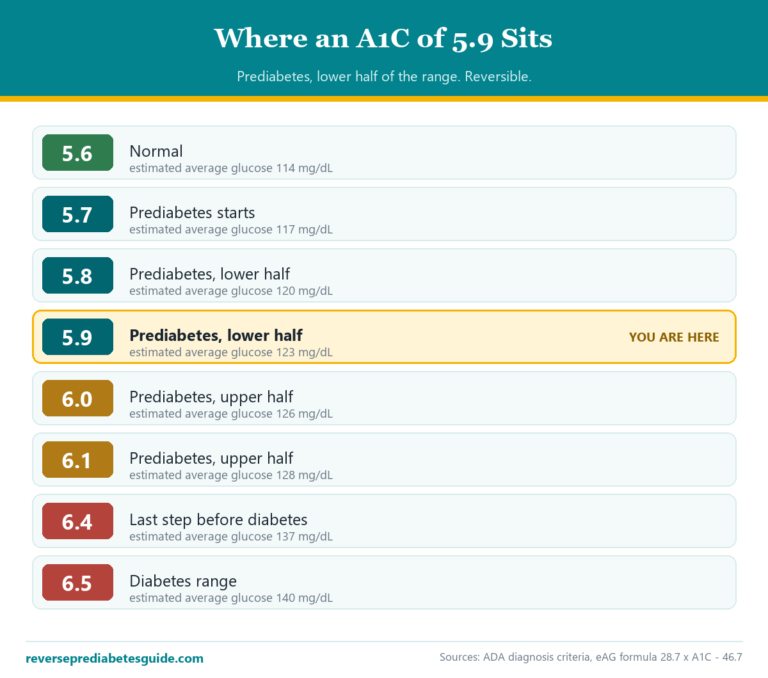
If you came here from the lower end of the range, my breakdown of what an A1C of 5.9 means covers the same ground from the other side, and it is worth reading if you are trying to understand the direction you are moving in.
Key Takeaways
- 6.1 is prediabetes, in the high range, and 0.4 below the 6.5 diabetes cutoff.
- 6.1 works out to an estimated average blood sugar of roughly 128 mg/dL.
- Metformin is usually not prescribed at 6.1 unless other risk factors apply.
- Lifestyle change beat metformin in the Diabetes Prevention Program trial, 58 percent versus 31 percent.
- A1C only reflects the last two to three months, so retesting sooner than three months tells you little.
- Mine went from 6.1 to 5.4 with diet changes and daily walking, without medication.
Frequently Asked Questions
Is 6.1 A1C diabetes?
No. An A1C of 6.1 is prediabetes. The diabetes threshold is 6.5 percent or higher according to the American Diabetes Association, and the prediabetes range is 5.7 to 6.4. At 6.1 you are 0.4 percentage points below a diabetes diagnosis, which is close enough to take seriously and far enough to act on.
Is an A1C of 6.1 dangerous?
It is not an emergency, but it is not nothing either. An A1C of 6.1 corresponds to an estimated average blood sugar around 128 mg/dL, and prolonged elevation at that level is associated with increased cardiovascular risk even before diabetes is diagnosed. The practical danger is not the number itself. It is ignoring it for three years.
Can 6.1 go back to normal without medication?
Yes, for many people. Mine did. I went from 6.1 to 5.4 through diet changes and daily walking, with no medication, and that is a common enough outcome that the Diabetes Prevention Program built an entire national program around it. It is not guaranteed for everyone, and the honest caveat is that results depend on your individual biology, so track your own numbers with your doctor.
Why do I have no symptoms at 6.1?
Because most people do not have symptoms at 6.1, and that is exactly why prediabetes goes undetected. The CDC estimates that the large majority of people with prediabetes do not know they have it. Symptoms like excess thirst and frequent urination generally show up at much higher blood sugar levels. Feeling fine at 6.1 is normal and is not evidence that the result was wrong.
What is the difference between 6.1 and 6.4?
Both are prediabetes, but 6.4 is at the very top of the range and one tenth of a point from a diabetes diagnosis. In estimated average glucose terms the gap is roughly 128 mg/dL versus 137 mg/dL. Clinically the bigger difference is in how the conversation goes: at 6.4, preventive medication is more likely to be discussed, and retesting is more likely to be scheduled tightly. At 6.1 the default is usually lifestyle first.
How long should I wait before retesting my A1C after 6.1?
About three months, and not less. A1C measures the average over the roughly 120-day lifespan of your red blood cells, so an earlier test is still largely reporting the old you. The NIDDK explains the mechanism. Book the retest at the same appointment where you got the 6.1 so it actually happens.
The number 6.1 scared me into action, and the action was smaller than I expected. A walk after dinner. Water instead of soda. Protein at breakfast. Not eating bread by itself. That was most of it, and most of it was free.
You are not behind. You found out early enough to do something, which is more than most people at this number get.
Your Next Three Steps
- Look up your previous A1C results so you know your direction, not just your position.
- Book your three-month retest now, not later.
- Walk for ten minutes after your largest meal tonight.
Medical disclaimer: I am not a doctor, a nurse, or a dietitian. This article is for informational purposes only and reflects my personal experience with an A1C of 6.1. It is not medical advice and is not a substitute for professional care. Prediabetes is a medical condition, and everyone’s numbers, medications, and health history are different. Always talk with your doctor before making changes to your diet, exercise, or supplement routine, and never stop or delay prescribed treatment based on something you read online.