How Many Carbs Per Day With Prediabetes? (Real Numbers, Not Vague Advice)
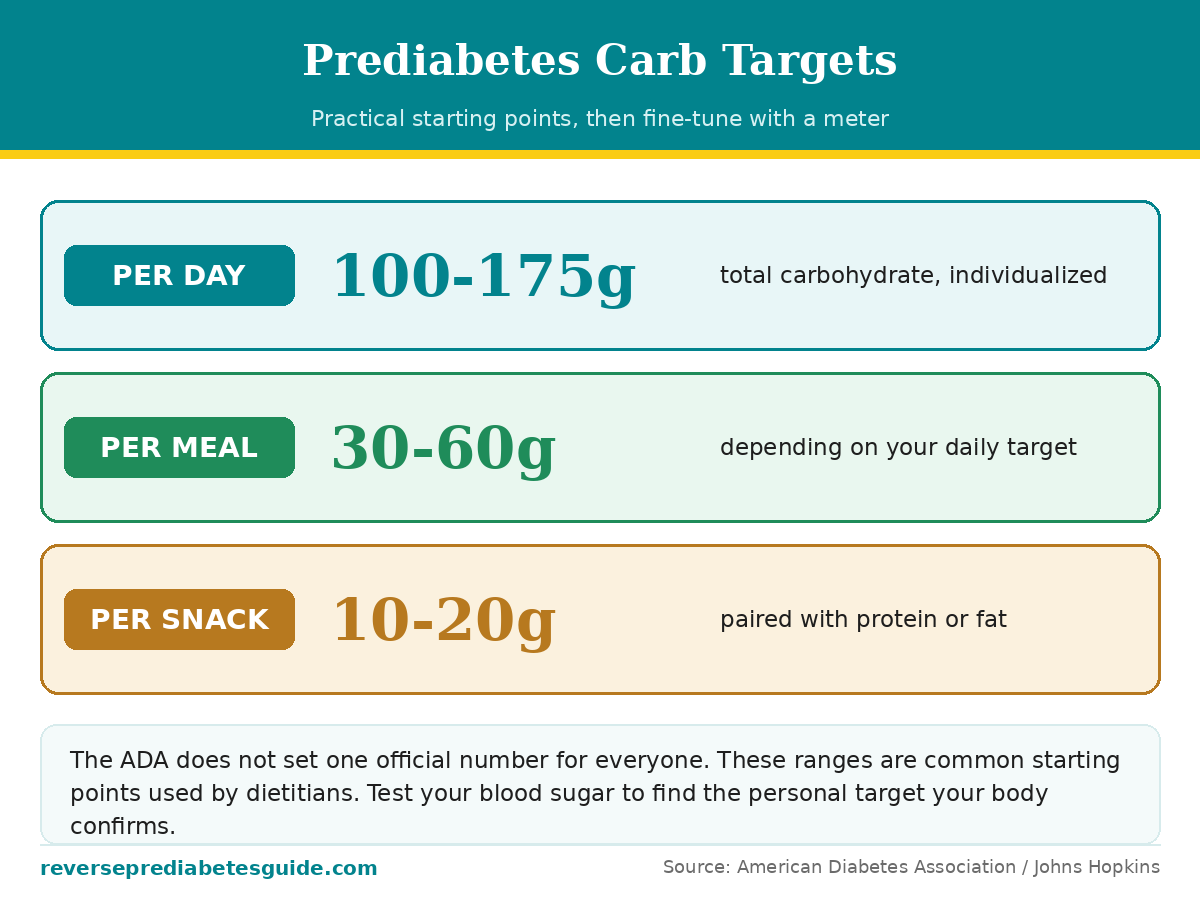
Quick Answer: There is no official single carb number for prediabetes, because the American Diabetes Association recommends an individualized approach. In practice, most adults with prediabetes do well on about 100 to 175 grams of total carbohydrate per day, which works out to roughly 30 to 60 grams per meal and 10 to 20 grams per snack. Lower ranges of 100 to 130 grams tend to lower blood sugar and support weight loss faster. Use a glucose meter to fine-tune your personal number.
When I asked my doctor how many carbs per day I should eat with prediabetes, she said “it depends.” I nodded politely, drove home, and felt more lost than when I walked in.
I did not want a philosophy. I wanted a number. Something I could write on a sticky note and actually follow at breakfast the next morning.
So I went digging, and I found that “it depends” is technically true but practically useless. There are real, defensible ranges that dietitians use as starting points, and there is a simple way to find the number that fits your body specifically.
This is the guide I wish someone had handed me the day I got my A1C result of 6.1. I will give you the actual grams first, because that is what you came for, and then I will show you how to personalize them.
Why there’s no single official carb number
Let me get the honest part out of the way, because it matters. The American Diabetes Association does not publish one magic carb number for everyone with prediabetes. According to Johns Hopkins, the ADA supports an individualized approach instead.
Your ideal intake depends on your blood sugar control, your weight goals, your activity level, the medications you take, and honestly, what you can stick with for the long haul. A marathon runner and a mostly sedentary office worker do not need the same amount of fuel.
That is why every credible source hedges. They are not being evasive. They are being accurate.
Here is the thing though. “Individualized” does not mean “unknowable.” Dietitians still start their clients somewhere, and that somewhere falls in a fairly predictable range. So let me give you the practical starting points, and then we will tune them to you.
The practical carb range for prediabetes (real grams)
These numbers are practical starting points used by dietitians, not an official ADA prescription. Think of them as a launchpad, not a ceiling carved in stone.
Carbs per day
Most adults with prediabetes do well somewhere in the range of 100 to 175 grams of total carbohydrate per day. That is a wide range on purpose, because bodies differ.
If your main goals are lowering blood sugar and losing weight, the lower end tends to move the needle faster. A target of 100 to 130 grams per day is where a lot of people start seeing quicker results.
For context, Johns Hopkins describes a “low-carb” pattern as roughly 150 to 200 grams per day, or about 30 to 40 percent of calories on a 2,000 calorie diet. So the ranges here are not extreme. They are moderate and sustainable.
Going below 100 grams per day can work for some people, but I would only do that with a doctor or dietitian watching your labs, especially if you take any blood sugar medication.
This article is educational and not medical advice. Talk with your doctor before dropping below 100 grams a day, particularly if you are on medication.
Carbs per meal
Now let us do the arithmetic, because this is where it clicks. If you eat three meals a day and land around 100 to 175 grams total, that shakes out to roughly 30 to 60 grams of carbs per meal.
Here is the math. Take 150 grams for the day, subtract about 30 to 40 grams for snacks, and you have around 110 to 120 grams left for three meals. Divide that up and you get somewhere near 35 to 40 grams per meal. Simple.
I found that thinking per-meal was far easier than tracking a daily total in my head. I only had to ask one question at each plate: is this meal roughly in the 30 to 60 gram zone?
Carbs per snack
Snacks are where a lot of us quietly blow the daily number without noticing. A handful of this, a bite of that, and suddenly you are 60 grams over.
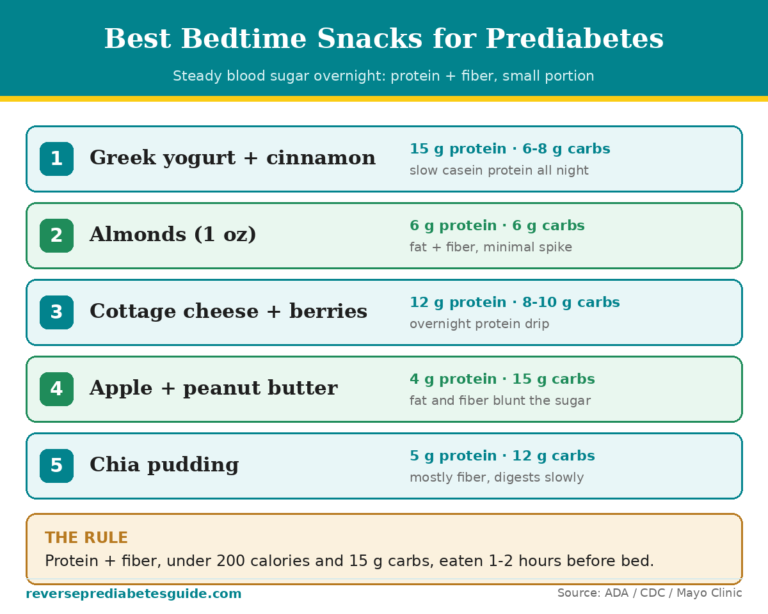
Aim for 10 to 20 grams of carbs per snack. An apple with peanut butter, a small Greek yogurt, or a few crackers with cheese all fit comfortably in that window.
| Target | Typical range | Faster-results range |
|---|---|---|
| Per day | 100 to 175 g | 100 to 130 g |
| Per meal | 30 to 60 g | 30 to 45 g |
| Per snack | 10 to 20 g | 10 to 15 g |
Print that table. Stick it on your fridge. That alone puts you ahead of most people who are still stuck on “it depends.”

To make the daily number feel concrete, here is what common portions actually cost you in carbs.
| Food (typical portion) | Approx. carbs |
|---|---|
| 1 cup cooked white rice | ~45 g |
| 1 medium banana | ~27 g |
| 2 slices white bread | ~26 g |
| 1 cup cooked lentils | ~40 g (with ~15 g fiber) |
| 1 medium apple | ~25 g |
| 1 cup non-starchy vegetables | ~5 to 8 g |
Notice how one cup of rice can eat almost half your daily budget on a lower-carb plan. That single realization changed how I built my plates.
How to find YOUR number (the meter test)
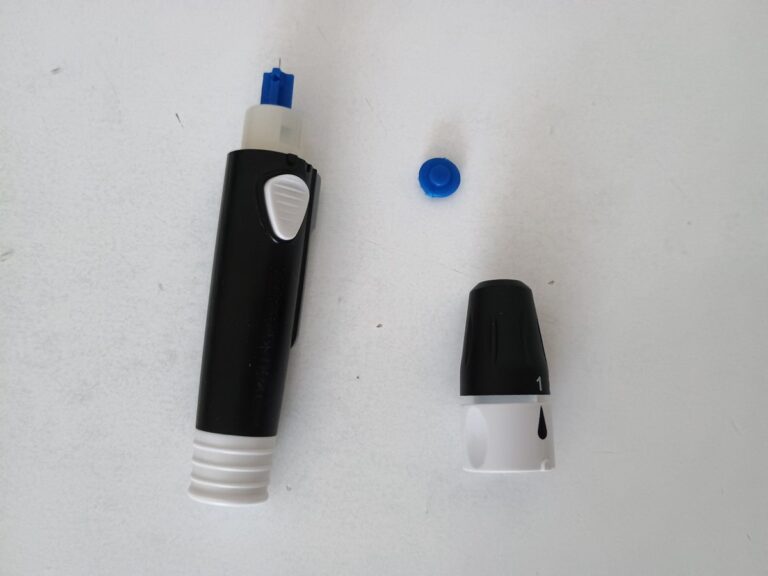
The ranges above are your starting line. To find the number that actually fits your body, you need data, and a cheap glucose meter gives it to you in about two weeks.
Here is the exact routine I used. It is simple enough to do at your kitchen table.
Step 1. Check your fasting blood sugar first thing in the morning, before eating or coffee. Do this every day so you have a baseline. Normal fasting sits under 100, and prediabetes runs 100 to 125 according to the American Diabetes Association.
Step 2. Eat a meal with a known carb amount, say 45 grams, and write it down.
Step 3. Test one hour after your first bite, then again at two hours. Watch the peak. You are looking for how high you spike and how fast you come back down.
If a 45 gram meal sends you soaring and keeps you high at two hours, that is your body telling you 45 grams is too much for that meal. Drop to 30 and test again. If you barely move, you may have a little more room.
I go deep on how to read these post-meal numbers in my guide to blood sugar after eating with prediabetes, and you can compare your readings against normal blood sugar levels by age to see where you land.
After two weeks of this, you will know your personal carb ceiling per meal better than any generic chart could ever tell you. That is the whole game.
Amount is only half the story: the type matters too
Here is what surprised me most. Two meals with the exact same number of carb grams can do completely different things to your blood sugar. The amount is only half the story. The other half is the type of carb.
Fiber slows everything down. A cup of lentils and a cup of white rice have similar carb counts, but the lentils come loaded with fiber that blunts the spike. The rice hits fast and hard.
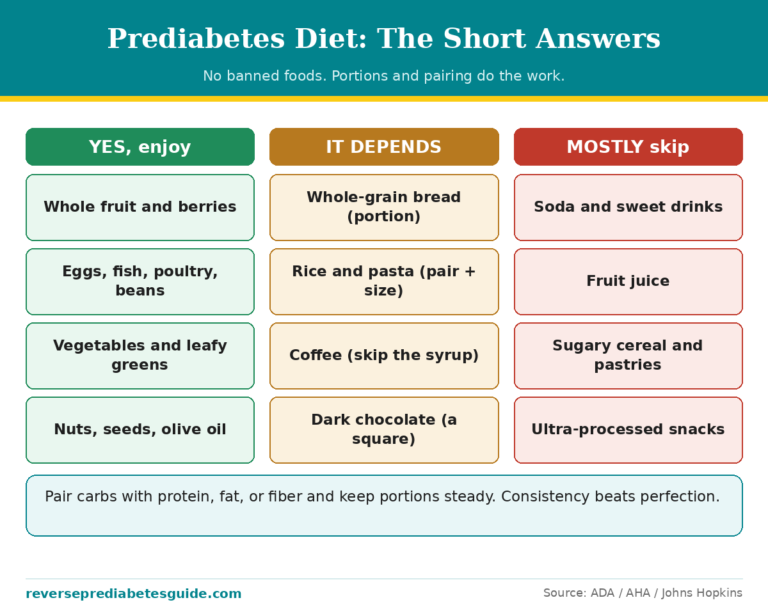
This is the glycemic index at work. Whole, intact foods with fiber and protein tend to raise blood sugar gently. Refined foods like white bread, sugary cereal, and juice raise it sharply, even at the same gram count.
So when you build a plate, think about quality alongside quantity. I learned which morning foods keep me steady in my roundup of low glycemic index breakfast foods, and I leaned hard on the foods that lower blood sugar quickly to fill out the rest of my day.
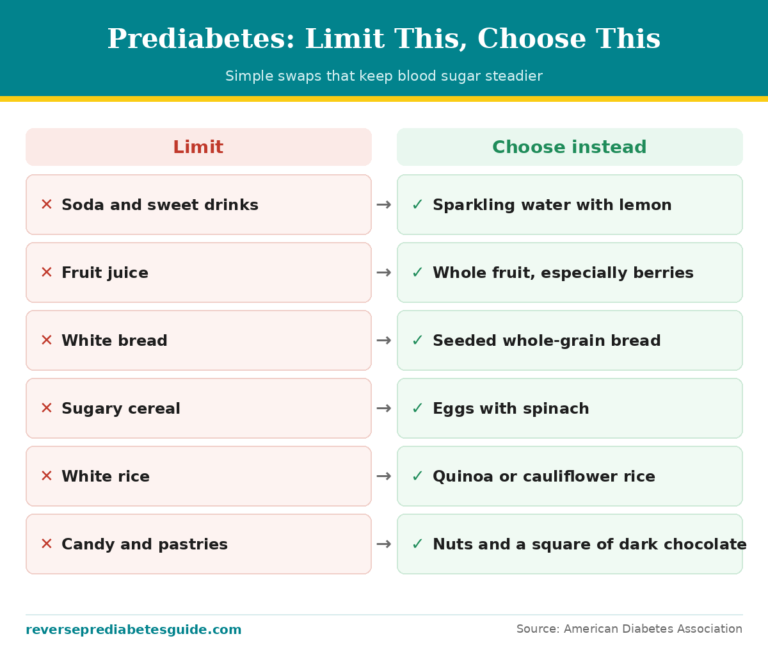
A few swaps that gave me the same carbs with a calmer response:
| Instead of | Try | Why it helps |
|---|---|---|
| White rice | Lentils or quinoa | More fiber, slower rise |
| White bread | Sprouted or dense whole grain | Lower glycemic response |
| Fruit juice | Whole fruit | Fiber intact, less spike |
| Instant oats | Steel-cut oats | Digests more slowly |
Same gram count on paper. Very different result in your bloodstream.
What my carb target looked like (A1C 6.1 to 5.4)
People ask me for my exact number, so here it is. I settled around 120 to 130 grams of total carbs per day, spread as roughly 30 to 40 grams per meal with a couple of 15 gram snacks.
I did not land there on day one. I started around 150 grams, watched my meter, and slowly trimmed to where my one-hour readings stayed reasonable. It took me a few weeks of tinkering to find that sweet spot.
Over about eight months, my A1C dropped from 6.1 to 5.4. Since A1C reflects your average blood sugar over the past two to three months, per the NIDDK, that number only moves when your daily habits genuinely change. It is a slow, honest mirror.
I want to be clear about one thing. I did not count every gram forever, and I do not want you to either. The counting was training wheels. After a few months, I could eyeball a plate and know it was in range. It became awareness, not obsession.
If you want a done-for-you version of these numbers, my 7-day prediabetes meal plan lays out portions that already fit these targets, and my prediabetes grocery list makes the shopping trip painless.
Beyond carbs: the levers that helped most
Carbs were my biggest lever, but they were not my only one. A few other habits made my numbers noticeably better, sometimes without me touching the carb count at all.
Pairing. I stopped eating carbs naked. Adding protein, fat, or fiber to a carb slows the rise. A slice of bread alone spiked me. The same bread with eggs barely moved me.
Walking after meals. This one felt almost too easy. A ten to fifteen minute walk after eating pulled my post-meal readings down every single time. I broke down why in walking after meals and blood sugar.
Timing and fasting. Giving my body a longer overnight break helped my fasting numbers settle. I share what worked for me in intermittent fasting for prediabetes.
Once your carbs and walking are dialed in, you may wonder about supplements. I read one liquid formula’s full label, kit prices and refund terms in my Olivaro review, and I compare the wider category in my guide to the best supplements for prediabetes to lower A1C.
Affiliate disclosure: some links in this article are affiliate links, which means I may earn a small commission if you buy through them, at no extra cost to you. That never changes the numbers or the honest advice here. A supplement is also not a substitute for food changes or medical care. Reversal happens through diet, movement, and your doctor’s guidance, so treat any product as an extra, not the foundation.
Key Takeaways
- There is no official single carb number for prediabetes, because the ADA recommends an individualized approach.
- A practical starting range is 100 to 175 grams of total carbs per day.
- That breaks down to roughly 30 to 60 grams per meal and 10 to 20 grams per snack.
- The lower end, around 100 to 130 grams, tends to lower blood sugar and support weight loss faster, ideally with guidance.
- The type of carb matters as much as the amount, so favor fiber-rich whole foods over refined ones.
- A glucose meter and a two-week test are the fastest way to find your personal number.
Frequently Asked Questions
Is 100 grams of carbs a day too low for prediabetes?
For most people, 100 grams a day is a reasonable lower end and sits above a very-low-carb ketogenic level. It is not too low for the average adult, but if you take blood sugar medication or feel unwell, check with your doctor before staying there long term.
How many carbs to reverse prediabetes?
There is no single reversal number, but many people see A1C improve on 100 to 130 grams of total carbs per day paired with movement and weight loss. Reversal comes from consistent habits over months, not one perfect figure. My full walkthrough is in the complete guide to prediabetes.
Can I eat no carbs at all?
You do not need zero carbs, and I would not aim for it. Vegetables, legumes, and fruit carry fiber and nutrients your body benefits from. The goal is choosing better carbs in sensible amounts, not eliminating them entirely.
How many carbs per day to lower A1C?
Since A1C reflects your average blood sugar over two to three months, lowering it means keeping daily carbs in a range your body handles well, often 100 to 150 grams. Use your meter to confirm your meals are not spiking you, and give it a full quarter to show up on a lab.
Does counting net carbs vs total carbs matter?
Total carbs is the simpler, safer number to track when you are starting out. Net carbs subtract fiber, which can be useful, but food labels vary in how they calculate it. I recommend beginning with total carbs until you know your body’s patterns.
How many carbs for prediabetes and weight loss?
The lower end of the range, around 100 to 130 grams per day, tends to support weight loss while also steadying blood sugar. Pair it with protein and non-starchy vegetables so you stay full, and lean on my just diagnosed prediabetes 30-day plan to structure the first month.
Will cutting carbs alone reverse prediabetes?
Cutting carbs is powerful, but it usually works best alongside movement, weight loss, and better sleep. I got my biggest wins by combining a moderate carb target with post-meal walks. Think of carbs as the main lever, not the only one.
Before You Go
- Start at 30 to 45 grams of carbs per meal this week and see how your body responds.
- Buy a cheap glucose meter and run the two-week test to find your personal number.
- Swap one refined carb for a fiber-rich version at your next meal, same grams, calmer spike.
- Take a ten-minute walk after your largest meal and watch what it does to your reading.
If “it depends” left you as frustrated as it left me, I hope these numbers give you something you can actually act on today. You do not need a perfect plan. You need a place to start and a way to adjust, and now you have both.
When you are ready to see these numbers on a real plate, my 7-day prediabetes meal plan shows these numbers in action, meal by meal, so you never have to guess.